India's No.1 PU & Degree With Integrated IAS & IPS(UPSC/PSC) Training College.


Artemis II: NASA’s 2025 Return to the Moon
NASA’s Artemis II Mission (2025): Paving the Path for Lunar Exploration
Introduction: A New Era in Space
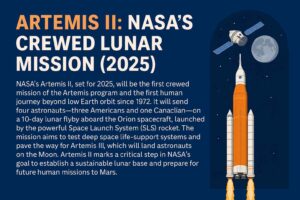
In 2025, NASA Artemis is set to make history once again with the launch of Artemis II, the first crewed mission to the Moon in over five decades. This ambitious Artemis moon mission will carry four NASA astronauts around the Moon, testing cutting-edge space systems and preparing the path for future lunar landings and, eventually, Mars exploration. Artemis II is more than just a milestone in science — it’s a giant leap for the future of human spaceflight and humanity’s presence in space.
The Artemis Program: A New Chapter in Lunar Exploration
The Artemis Program, named after the Greek goddess of the Moon and twin sister of Apollo, is NASA’s next-generation lunar exploration initiative. The program’s goal is not just to revisit the Moon, but to stay, build, and go beyond. The Artemis Accords, a set of principles for peaceful exploration, underpin this international effort.
The Artemis 1 launch in 2022 marked a crucial uncrewed test flight that orbited the Moon and returned to Earth. Artemis II (2025) will be the first crewed mission, flying astronauts around the Moon in a free-return trajectory. The Artemis III mission (2026/27) aims to land humans on the lunar surface, including the first woman and the first person of color. Looking ahead, the Artemis 4 mission will further expand lunar exploration capabilities and contribute to the establishment of a sustainable presence on the Moon.
Artemis II: Mission Overview
Artemis II is a crewed lunar flyby mission that will last approximately 10 days. The Artemis II launch will take place from Kennedy Space Center in Florida, using NASA’s powerful Space Launch System (SLS) rocket. The mission will follow a free-return trajectory around the Moon, allowing the Orion capsule to swing around the Moon and return safely to Earth. Key mission objectives include testing life support systems, navigation capabilities, and orbital insertion procedures.
The four-member crew includes three Americans and one Canadian. They will travel aboard the Orion capsule, which will be tested in real spaceflight conditions with humans onboard for the first time. The mission will also involve proximity operations near the Moon, providing valuable experience for future lunar missions.
Meet the Historic Artemis II Crew
NASA’s Artemis 2 astronauts were announced in April 2023, marking a historic step in space exploration:
- Reid Wiseman (Commander, USA)
- Victor Glover (Pilot, USA) – First person of color on a Moon mission
- Christina Koch (Mission Specialist, USA) – Will be the first woman to orbit the Moon
- Jeremy Hansen (Mission Specialist, Canada) – First Canadian to fly to the Moon
These Artemis 2 astronauts represent the values of diversity, inclusion, and international collaboration in space.
Technology Behind the Mission
The Orion capsule is designed for deep-space missions. It is equipped with advanced life support systems, navigation tools, and a heat shield to withstand high-speed reentry. The SLS rocket is the most powerful rocket ever built by NASA, capable of sending Orion and its crew beyond low Earth orbit. NASA’s Deep Space Network will maintain communication with the spacecraft throughout the mission.
The mission will also utilize a mobile launcher and exploration ground systems to support the launch and early flight phases. Scientific instruments onboard will gather crucial data about the lunar environment. Additionally, the mission will test advanced optical communications systems for improved data transmission between Earth and the spacecraft.
The launch escape system is a critical component, ensuring crew safety in case of any launch anomalies. The Mission Control Center in Houston will play a pivotal role in guiding the astronauts through their journey, including the critical orbital insertion maneuver around the Moon.
Strategic Significance of Artemis II
Artemis II is a vital step in testing technologies and systems for future lunar missions, including the Artemis III mission. It supports the development of the Lunar Gateway, a planned orbiting station around the Moon, and the Human Landing System for future surface missions. The mission also strengthens U.S. leadership in space at a time when global competition, especially from China and Russia, is growing.
With strong support from partners like ESA, JAXA, and CSA, as well as involvement from commercial contractors, Artemis represents a new model of international space cooperation. The mission’s significance can be compared to that of the International Space Station, as it sets the stage for long-term human presence beyond low Earth orbit.
Challenges and Risks
Despite its promise, Artemis II faces several challenges in deep space exploration. These include exposure to the harsh radiation environment in lunar orbit, which is much higher than in low Earth orbit, as well as technical complexities and budgetary constraints. The mission’s success also depends on a robust supply chain for critical components and systems.
As the first deep-space crewed mission in over 50 years, safety and contingency planning are top priorities. Potential mission delays due to technical issues or unforeseen circumstances are always a concern in such complex endeavors. The NASA team and its partners are working diligently to address these challenges and ensure mission success.
From Moon to Mars: The Bigger Picture
NASA sees the Artemis missions as a stepping stone to Mars. The technologies, systems, and lessons learned from Artemis II will be critical for longer missions in deep space. By the 2030s, NASA aims to send astronauts to Mars, and Artemis is laying the foundation for that historic journey. In-situ resource utilization will be crucial for these extended missions, with astronauts learning to harness lunar resources for sustenance and fuel production.
Conclusion
Artemis II marks a powerful return to crewed lunar missions and a significant milestone in human spaceflight. It symbolizes more than just scientific achievement—it represents a renewed global commitment to space exploration, innovation, and unity. With its diverse crew, advanced technologies, and strategic goals, Artemis II is not just about going to the Moon. It’s about building a future where humanity lives, works, and thrives beyond Earth, paving the way for sustainable lunar exploration and eventual Mars missions. As we look to the stars, Artemis II stands as a beacon of human ingenuity and our unrelenting quest to explore the unknown.